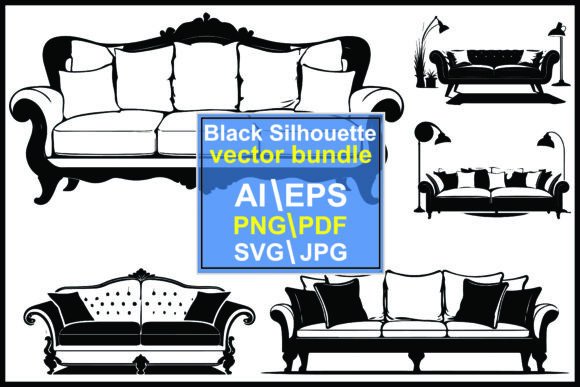
Sofa Set Furniture Silhouette Vector
First Impression: Clean, Timeless, and Quietly Sophisticated
Opening Sofa Set Furniture Silhouette Vector, I immediately notice its quiet confidence — no loud gradients, no forced trends, just strong black-and-white silhouettes of sofas ranging from mid-century modern to ornate tufted classics. It’s not “cute” or “playful.” It’s deliberate. Thoughtful. The kind of design that whispers “interior designer’s mood board” rather than shouts “craft fair booth.” As an embroidery designer who’s stitched everything from baby onesies to boutique aprons, I appreciate how clearly these silhouettes translate to stitch: clean outer lines, intentional negative space, and consistent weight across forms. That matters — a lot — when you’re converting vector to machine embroidery.
A Real-World Test: Embroidering a Linen Pillow Cover for a Home Goods Boutique
Last week, I prepped Sofa Set Furniture Silhouette Vector for a custom linen pillow cover order — part of a small-batch collection for a local home goods shop. The client wanted subtle, elevated branding: no logos, just refined visual cues customers would recognize as “intentional design.” I chose the most streamlined silhouette — a low-profile modern sofa with clean arm lines — sized to fit a 4x4 hoop comfortably. On natural linen, with matte black thread and medium-weight tear-away stabilizer, it stitched cleanly in under 8 minutes. No skipped stitches. No thread breaks. The fill stitch settled evenly, and the satin-stitched outline held crisp definition without puffing. Customers responded well: “It feels like a detail only someone who loves furniture would notice.” That’s the sweet spot — where Sofa Set Furniture Silhouette Vector earns its keep.
Where It Shines (and Where It Needs Care)
This collection works beautifully for:
- Embroidered tote bags and tea towels — the bold outlines hold up against casual handling and frequent washing;
- Baby and nursery items — think crib bumper tags or organic cotton swaddle labels; the classic silhouettes feel warm, not sterile;
- Custom sweatshirts and unisex apparel — especially on heather grey or oatmeal fabrics where contrast stays soft but legible;
- Patches and iron-ons — clean edges mean sharp cutouts and minimal fraying;
- Digital product previews — perfect for printable mockups on Etsy listings or Instagram product carousels.
But be thoughtful with placement and context:
- Avoid dense stitching on stretchy knits — these silhouettes rely on shape integrity, and heavy fill stitch can distort seams on t-shirts or baby bodysuits;
- Double-check hoop size before digitizing — some ornate versions include fine scrollwork near the legs or backrests that may push limits on smaller hoops (3x3 or less);
- Test on textured fabric first — bouclé, corduroy, or thick terry cloth can mute fine line work, especially in tufted or highly detailed variants;
- Dark fabric demands contrast discipline — while black-on-cream reads elegantly, black-on-charcoal or navy needs extra stabilizer support and possibly a lighter thread tone to avoid visual heaviness;
- Caps and curved surfaces need simplified versions — the full ornate silhouette loses clarity on a baseball cap front; choose the cleanest, most geometric variant for those applications.
What It Adds to Your Finished Product — Beyond Stitch Count
Sofa Set Furniture Silhouette Vector doesn’t just fill space — it signals intention. When used on a handmade apron for a ceramicist’s studio, it quietly reinforces craft, curation, and aesthetic cohesion. On a holiday gift set (pillow + matching kitchen towel), it ties the collection together without needing words. For Etsy sellers, that consistency builds trust: buyers see a unified visual language across listings and assume higher production standards. And because it’s vector-based, scaling is flexible — whether you’re embroidering a tiny 1.5" patch for a keychain or a bold 6" motif on a blanket, the integrity holds. That adaptability makes it unusually valuable for creative entrepreneurs juggling multiple product types.
Practical Designer Notes Before You Stitch
Before committing to your next project:
- Always test on scrap fabric — especially if using textured, dark, or lightweight material;
- Review stitch density — some versions may layer fill and satin too closely for delicate fabrics; adjust if needed;
- Confirm licensing — since this is categorized as Illustrations and Graphics, verify commercial use rights before selling finished embroidered goods or bundling into digital embroidery files;
- Check thread color contrast — black thread on black fabric won’t read, even with crisp silhouettes;
- Use proper stabilizer — medium-cutaway works best for knits; tear-away suffices for stable wovens like linen or cotton duck;
- Inspect small details — zoom in on tufting dots or arm curvature; ensure they’ll resolve at your target size;
- Mock it up in black and white — this design lives in high contrast, so skip color previews and focus on tonal balance;
- Compare light vs. dark backgrounds — what reads as elegant on ivory may feel stark on charcoal unless adjusted.
Final Thought: A Design That Respects the Craft
Sofa Set Furniture Silhouette Vector isn’t flashy — and that’s its strength. In a landscape crowded with overdesigned, trend-chasing assets, it offers restraint, versatility, and quiet authority. It supports your voice instead of competing with it. Whether you’re stitching personalized gifts for new homeowners, building a cohesive line of boutique merchandise, or creating digital embroidery files for fellow makers, this collection delivers reliable, professional-grade foundation work. It’s the kind of design that disappears into the product — until someone pauses, leans in, and says, “I love the little sofa detail.” That’s when you know it’s working.