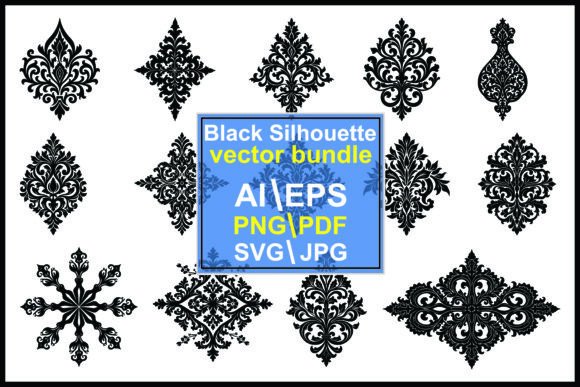
Silhouette Ornament Patterns and Borders
First Impressions: A Quietly Confident Vintage Presence
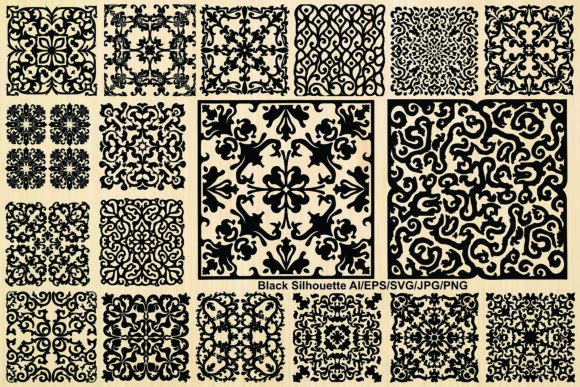
When I opened Silhouette Ornament Patterns and Borders, I didn’t see “just another black-and-white graphic.” I saw a collection that breathes Baroque restraint and Rococo rhythm—without shouting. The symmetry is precise but never stiff; the filigree swirls have weight and flow, not fragility. These aren’t clip-art fillers. They’re design assets with intention: balanced negative space, consistent line weight, and a subtle hierarchy of detail that translates beautifully to stitch. As an embroidery designer who’s stitched everything from baby onesies to boutique aprons, I immediately pictured this on a linen tea towel—elegant enough for a wedding gift, grounded enough for everyday kitchen use.
A Real-World Test: Stitching It onto a Linen Tote Bag
Last week, I used one of the border motifs from Silhouette Ornament Patterns and Borders to frame the bottom edge of a custom linen tote for a local herbalist’s shop. Why this design? Because it held visual authority without overwhelming the hand-stitched herb labels inside—and because its clean silhouette meant no guesswork when converting to a machine embroidery design. On medium-weight linen, the scrollwork read clearly in satin stitch, and the open areas stayed crisp with minimal fill stitch density. Customers noticed it—not as “busy decoration,” but as quiet craftsmanship. That’s the difference between decorative clutter and intentional ornamentation.
Where It Shines (and Where It Asks for Thought)
Silhouette Ornament Patterns and Borders excels in projects where elegance meets durability:
- Custom apparel: Sweatshirt cuffs, collar accents, or back-of-cap borders—its symmetrical structure adapts well to curved surfaces when scaled thoughtfully.
- Baby embroidery: Swaddles, bibs, and nursery pillows benefit from its gentle formality—no sharp angles, no fussy micro-details that snag or fray.
- Embroidered patches: The high-contrast black-and-white base makes digitizing clean, especially for applique designs where edge definition matters.
- Holiday and wedding gifts: Think monogrammed pillow covers or heirloom-style kitchen towels—this collection feels timeless, not trend-dependent.
- Etsy listings and small shop branding: As design assets, these patterns lend cohesion across product lines (e.g., matching tea towel + apron + napkin set) without requiring full custom illustration.
Use With Care: Practical Embroidery Boundaries
This isn’t a one-size-fits-all motif. Its strength lies in balance—and imbalance reveals limits:
- Small hoop sizes (under 4”): Some central medallions include fine interior scrolls. Test first on scrap—running stitch may struggle to define them at tiny scales.
- Textured or stretchy fabric: On terry cloth towels or lightweight jersey, dense filigree areas can pucker. Use cutaway stabilizer and reduce stitch density slightly.
- Dark fabric: Since these are black-and-white illustrations, contrast depends entirely on thread choice. A charcoal thread on navy won’t pop like white-on-black—always mock up in both directions.
- Curved surfaces (caps, curved hems): Avoid placing intricate corners directly over seams or crowns. Opt for repeating border segments instead of singular focal motifs.
- Frequent-wash items (baby clothes, kitchen linens): Tight scrollwork holds up best with quality polyester thread and secure underlay—don’t skip the test run on actual garment fabric.
What It Adds to Your Finished Product—Beyond Looks
Using Silhouette Ornament Patterns and Borders does more than decorate—it signals care. Customers don’t just buy a tote bag; they buy something that *feels* considered. That perception lifts perceived value, builds trust in your handmade product, and strengthens brand consistency—especially if you layer it across multiple items. For Etsy sellers, it elevates listing thumbnails (clean lines scale well digitally) and printable mockups. For craft fair vendors, it adds quiet sophistication to otherwise simple pieces—like turning a plain cotton apron into a boutique-ready statement. And yes—it works commercially: as long as your license permits finished-product resale, this is embroidery project fuel that supports scalable, repeatable quality.
Designer Notes You’ll Actually Use
Before stitching—or listing—take these steps:
- Test on scrap fabric identical to your final piece (linen ≠ cotton duck ≠ knit).
- Check thread color contrast in natural light—not just on screen. White thread on ecru linen reads softer than on stark white.
- Review stitch density in your embroidery software. If fill areas look muddy, simplify or adjust underlay.
- Confirm hoop size compatibility. Some borders span wider than standard 5x7 hoops—plan layout early.
- Inspect small details at 200% zoom. Are inner loops legible? Will they stitch cleanly at your chosen size?
- Test black-and-white mockups on both light and dark backgrounds—this is core to how Silhouette Ornament Patterns and Borders functions.
- Match stabilizer to fabric type. Medium-weight cutaway for stable wovens; tear-away + topping for knits.
- Verify licensing before selling finished embroidered items or bundling as digital embroidery files.
Final Thought: Ornament That Earns Its Place
Not every ornamental pattern earns real-world embroidery time. Many fade into background noise—or worse, create stitching headaches. Silhouette Ornament Patterns and Borders avoids both traps. It’s detailed enough to feel special, disciplined enough to stitch reliably, and versatile enough to move between baby embroidery and boutique merchandise without losing its voice. It doesn’t try to be everything. It simply does what ornamental graphics should do: frame, elevate, and quietly say, “This was made with attention.” That’s the kind of design that keeps crafters coming back—and customers remembering.