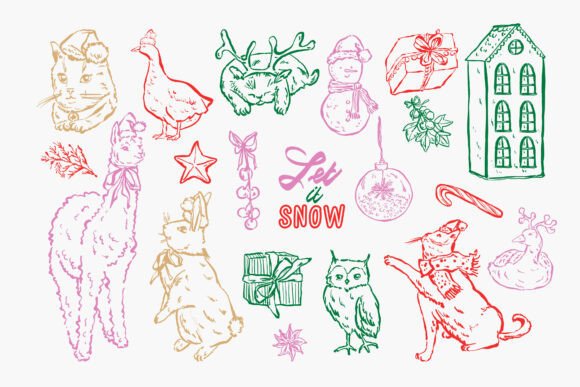
Whimsical Hand Drawn Christmas Animals
A Designer’s First Look: Charm with Clear Intent
Opening Whimsical Hand Drawn Christmas Animals feels like flipping through a sketchbook left on a cozy studio desk—loose linework, gentle imperfections, and a warmth that digital precision often misses. This isn’t a tight vector logo or a hyper-detailed clipart set. It’s expressive illustration translated into embroidery-ready form: friendly foxes in scarves, sleepy owls with holly crowns, reindeer with wobbly antlers, plus snowflakes, candy canes, and tiny presents—all drawn with the same light, confident hand. The mood is joyful but grounded—not cutesy to the point of saccharine, not so stylized that it loses readability when stitched.
How It Stitches: Real-World Embroidery Behavior
I tested Whimsical Hand Drawn Christmas Animals on a medium-weight cotton tote bag and a brushed cotton baby onesie—two very different surfaces, both common for craft businesses and Etsy sellers. On the tote, the design held its character beautifully: the sketch-like outlines translated well into satin stitch borders, while open areas used subtle fill stitch without overwhelming texture. On the onesie, I reduced size slightly and added lightweight tear-away stabilizer—critical for thin fabric—and the result was soft, legible, and distinctly handmade. No bleeding, no puckering, no thread nests in corners.
This collection shines in projects where personality matters more than polish: embroidered sweatshirt cuffs, kitchen tea towels with scattered animals, patch sets for denim jackets, or pillow covers with one central critter framed by hand-drawn garlands. As an embroidery file, it avoids over-engineering—no dense satin fills where a running stitch would breathe better, no micro-details doomed to vanish at 3” width. That restraint makes it reliable across custom apparel, personalized gifts, and small shop product lines.
Where It Fits—and Where to Pause
Whimsical Hand Drawn Christmas Animals naturally suits flat, stable surfaces: tote bags, aprons, pillow covers, and structured caps (with proper hoop support). It performs well on medium-weave cottons, linen blends, and stable knits—but tread carefully on highly textured fabrics like bouclé or thick terry cloth. Those sketchy lines soften too much; detail blurs. Similarly, avoid using the smallest elements (like berry stems or whiskers) on dark fabric without testing contrast first. What reads as delicate on-screen may disappear under navy or charcoal thread.
For curved surfaces—like the front panel of a baseball cap—scale down generously. Some poses (a curled-up hedgehog, for example) rely on clean silhouette edges that distort if stretched across a dome. And while the set works beautifully as standalone embroidered patch art, don’t try to cram three animals + snowflakes into a 4” hoop without adjusting spacing. The charm lies in breathing room—not clutter.
What It Adds to Your Finished Product
Customers notice authenticity. A machine-embroidered fox from Whimsical Hand Drawn Christmas Animals doesn’t look mass-produced—it looks like something a small maker chose with care. That lifts perceived value on Etsy listings, boutique shelves, and holiday markets. It supports brand consistency for shops leaning into warm, approachable aesthetics—not corporate minimalism or vintage rigidity, but thoughtful, human-centered craft.
It also boosts buyer engagement. People pause longer on products where the embroidery tells a quiet story: a sleepy owl on a baby blanket invites touch and connection; a mismatched reindeer trio on a tea towel sparks a smile mid-kitchen task. That emotional resonance translates directly to repeat customers and word-of-mouth trust—especially for handmade product buyers who prioritize intention over speed.
Practical Notes Every Embroidery Designer Should Check
- Test on scrap fabric first—especially if stitching on stretchy or napped material. Sketch-style lines need stabilization that matches your base.
- Review stitch density before scaling up. Lighter fill areas may need slight density adjustment on heavy fabrics to avoid sinking.
- Confirm hoop size compatibility. While the SVG format offers flexibility, your actual machine embroidery design export must fit your standard hoops—don’t assume 5x7” will always suffice.
- Inspect small details at final size. A hand-drawn snowflake might read perfectly at 4”, but lose definition at 1.5”. Zoom in before sending to your machine.
- Try black-and-white mockups. This design relies on line weight and shape—not color—so grayscale previews reveal clarity gaps faster than full-color screens.
- Compare light vs. dark fabric backgrounds. Some elements use implied shading; test thread colors accordingly—cream on oatmeal, charcoal on ivory, forest green on cream.
- Use appropriate stabilizer: lightweight cut-away for knits, tear-away for stable wovens, and optional topping for napped fabrics.
- Verify licensing terms before selling finished items or bundling the digital embroidery file in kits. Since this is part of a broader Illustrations collection intended for creative use across print, confirm commercial rights apply to your specific use case.
Final Thought: Not Just Holiday Decor—A Design Language
Whimsical Hand Drawn Christmas Animals isn’t just seasonal filler. It’s a cohesive Graphics language—playful but precise, nostalgic but fresh—that extends beyond December. Swap out holly for lavender sprigs in spring, or trade candy canes for sunbursts in summer, and you’ve got adaptable design assets for year-round craft business growth. For anyone building a recognizable visual voice—whether on Etsy, at local fairs, or through custom client work—this set delivers more than motifs. It delivers mood, reliability, and quiet confidence in every stitch.