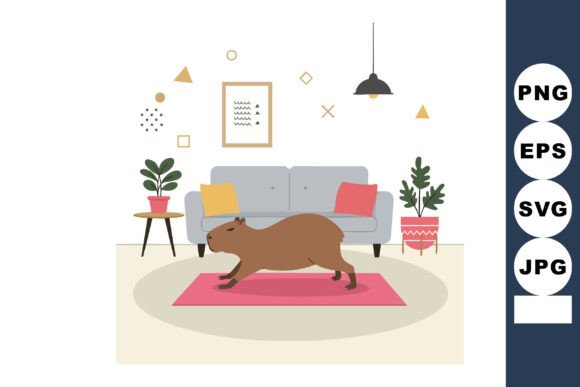
Capybara Inside Modern Living Room
A Cozy, Character-Driven Embroidery Design—But Not for Every Project
As a designer who’s stitched hundreds of illustrations onto everything from organic cotton baby onesies to heavyweight denim tote bags, I opened Capybara Inside Modern Living Room expecting charm—and got it instantly. The vector image shows a capybara ambling across a soft rug beside a low-slung sofa, potted plants spilling gently into the frame, cushions arranged with quiet intention. It’s undeniably warm, unhurried, and visually grounded. That relaxed mood? It translates directly to how customers respond to finished pieces: smiles, double-takes, genuine “I need that” energy. But here’s what matters more than first impressions—it’s how this design behaves under needle and thread.
Where It Shines: Lifestyle-Focused Handmade Products
This isn’t a logo or monogram. Capybara Inside Modern Living Room is an illustration built for storytelling—so it thrives where context and personality matter most. Think embroidered pillow covers for a boutique nursery, linen tea towels for a small shop’s holiday collection, or oversized sweatshirt fronts for a craft fair stall that leans into slow living and gentle humor. I recently tested it as a center chest embroidery on a midweight French terry sweatshirt (light heather grey), and the result felt intentional—not busy, not precious, just quietly confident. Customers paused to ask about the capybara’s “interior design credentials.” That kind of engagement is gold for Etsy sellers and handmade brands building recognition through warmth, not flash.
It also works beautifully as a custom embroidered patch. The clean outlines and balanced negative space mean satin stitch edges hold up well when heat-applied or sewn onto denim jackets or canvas backpacks. As a digital embroidery file, its SVG and EPS roots give solid scalability—no jagged edges when resized for a 4” hoop (ideal for tote bag handles) or stretched to 6.5” for a pillow cover centerpiece.
Where to Pause—And Why
Don’t reach for Capybara Inside Modern Living Room if your project demands high-density detail in tight spaces. Those little potted plants? Adorable in vector form—but their leaf clusters shrink fast below 3.5”. On a curved surface like a structured cap or a baby beanie, fine stems and cushion tufts risk blurring or stitching inconsistently without careful digitizing adjustments. Likewise, dense fill stitch areas (like the rug texture or sofa arm) can cause puckering on lightweight knits or stretchy jersey unless paired with cutaway stabilizer and reduced stitch density.
Dark fabric is another consideration. The original JPG and PNG previews rely on subtle tonal shifts—soft shadows under the sofa, gentle highlights on the capybara’s fur. In thread, those subtleties flatten without high-contrast color choices. I recommend testing Capybara Inside Modern Living Room in both black-on-cream and cream-on-navy mockups before committing to production runs. And if you’re embroidering on textured fabrics—bouclé, waffle-weave towels, or nubby linen—run a sample first. Some decorative elements (like the thin line art defining plant leaves) may disappear into the weave.
Real-World Fit: From Nursery Decor to Boutique Merchandise
I used Capybara Inside Modern Living Room for a set of personalized baby milestone blankets last month—embroidered at 5.25” wide on 100% cotton interlock. The scale felt generous but not overwhelming; parents loved how the scene evoked calm, safe spaces instead of typical cartoon animals. For holiday gifts, it’s a standout on kitchen towels or linen napkin sets—especially when paired with minimalist embroidery fonts for names or dates. As a printable mockup asset, its clean vector base makes it easy to drop into lifestyle scenes (think: flat lays with ceramic mugs and dried florals), helping Etsy sellers communicate tone before buyers even click “add to cart.”
That said, skip it for high-wear items like toddler socks or infant bibs where tiny details won’t survive repeated washing. And avoid using it as-is for commercial embroidery on layered garments (e.g., hoodies with thick fleece backing) unless you’ve confirmed stitch count and underlay settings—those interior lines and overlapping elements need thoughtful digitizing to avoid thread breaks or uneven coverage.
Practical Designer Notes Before You Stitch
- Always test on scrap fabric first—especially with your exact stabilizer, thread brand, and machine tension.
- Review thread color contrast carefully: light capybara fur against light backgrounds needs definition via outline stitches or tone-on-tone shading.
- Check whether the included files are native embroidery formats (they’re not—SVG/EPS/JPG/PNG require conversion). Confirm digitizing quality before stitching.
- Inspect small corners and intersections—like where the capybara’s leg meets the rug edge. These often need manual cleanup in embroidery software.
- Use proper stabilizer: medium-weight cutaway for knits, tear-away for stable wovens, and optional topping for nubby textures.
- Confirm licensing terms before selling finished products or digital embroidery files—this is an Illustrations asset, not pre-digitized Graphics for immediate machine use.
- Compare light/dark fabric mockups early—mood shifts dramatically depending on background value.
In short: Capybara Inside Modern Living Room is a strong, distinctive embroidery design for makers who value narrative over novelty. It elevates handmade product listings, adds warmth to custom apparel, and stands out in saturated markets—if you match it to the right fabric, scale, and customer expectation. It won’t solve every embroidery challenge, but in the right hands, it becomes more than decoration: it’s a quiet invitation to pause, smile, and feel at home.