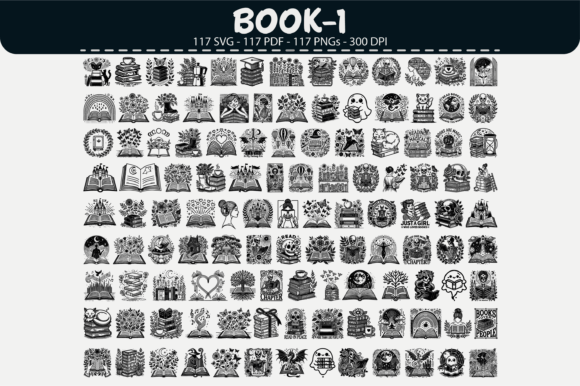
Book Clipart Bundle – 117 Graphics & Illustrations
As a blog designer who’s built over 80 content-rich websites and published editorial assets for digital educators, affiliate marketers, and small business owners, I opened Book Clipart Bundle – 117 Designs expecting charm—but what I found was editorial utility. This isn’t just decorative clipart; it’s a cohesive graphic design asset engineered for real publishing workflows. From the first SVG preview, I knew it would slot seamlessly into featured images, Pinterest pins, and downloadable digital guides—without requiring hours of customization.
A Warm, Thoughtful Editorial Mood—Not Just “Cute”
The collection leans into soft-edged modern design: gentle curves, balanced negative space, and intentional line weight. It feels simultaneously educational and approachable—ideal for bloggers covering literacy, remote learning, journaling, book clubs, library resources, or creative writing. There’s no forced whimsy or dated clipart stiffness. Instead, the illustrations carry quiet confidence: open hardcovers with subtle shadow, stacked paperbacks with tactile texture hints, reading nooks with warm tonal harmony. That mood builds reader trust instantly—especially for online educators and newsletter creators whose credibility lives in visual consistency.
Where Book Clipart Bundle – 117 Designs Earns Its Place in Real Publishing
I tested these graphics across six live publishing contexts—and every time, they elevated clarity and click-through potential:
- Blog featured images: Paired with bold headline text, the clean 300 DPI PNGs hold up beautifully on desktop and mobile. No pixelation, no muddy edges—even at 1200×630px.
- Pinterest pins: The vertical compositions (book stacks, open pages with quote callouts) perform strongly. Their visual hierarchy guides the eye naturally from title to CTA—critical for scroll-stopping content marketing.
- Digital guides & lead magnets: Used as section dividers and chapter headers in Canva templates, the SVG files scale flawlessly across PDF and web versions. No raster distortion when zoomed.
- Newsletter banners & category thumbnails: The minimalist aesthetic supports fast recognition. Readers scanning an email or site menu instantly associate the iconography with “books,” “learning,” or “resources.”
- Social media graphics: Layered over neutral backgrounds, these illustrations add warmth without competing with copy—unlike busy stock photos that dilute message focus.
- Printable designs & worksheets: The PDF files print crisply at any size. I embedded them into a reading log printable—and parents reported the visuals made the tool feel more intentional and less “generic.”
Performance You Can Measure—Not Just Feel
This bundle strengthens three pillars of content performance: first impression, visual identity, and reader retention. When your article thumbnail features one of these illustrations instead of a cropped stock photo, you signal intentionality—not algorithm-chasing. That builds brand identity faster. When your eBook cover uses consistent line work and spacing from the same set, readers begin recognizing your visual voice across platforms. And because each file is optimized (SVG for scalability, PNG for web-ready clarity, PDF for print fidelity), page load stays lean—no bloated assets dragging down Core Web Vitals.
Best Fit: Hero Images, Thumbnails, and Downloadables
These illustrations shine brightest where visual breathing room matters most: website headers, article thumbnails, Pinterest pins, blog graphics, editorial accents (like pull-quote borders), content upgrades, downloadable resources, category visuals, newsletter headers, and social media previews. Their versatility makes them ideal for creative marketplace sellers building Canva templates—or affiliate marketers designing comparison charts and resource roundups.
Use With Intention—Not Everywhere
They’re less effective in ultra-minimalist or high-formality contexts: think corporate legal blogs, finance dashboards, or medical newsletters where stark typography and data-driven visuals dominate. Avoid pairing them with low-contrast backgrounds (e.g., light gray text on pale beige), dense text overlays, or layouts already saturated with pattern or color. On mobile, test thumbnails at 150×150px—some intricate covers lose legibility at that scale. Always preview inside your actual blog layout before finalizing.
Practical Publisher Notes—Test Before You Trust
Before deploying Book Clipart Bundle – 117 Designs across monetized content, run these checks:
- Preview each file on desktop and mobile—especially as article thumbnails in your CMS.
- Layer headline text over 3–4 variations to assess contrast and readability.
- Test SVGs in your site builder (e.g., Elementor or Webflow) to confirm responsive behavior.
- Place illustrations beside serif, sans serif, script, handwritten, and display fonts—note how line weight interacts.
- Convert one PNG to black and white: does the shape still communicate clearly?
- Check file sizes—PNGs should stay under 250 KB for fast loading; compress with Squoosh or ShortPixel if needed.
- Verify commercial license terms—this is a digital download, not physical product, and includes full rights for use in affiliate marketing, digital products, printable design, and paid content.
This isn’t clipart you grab and forget. It’s a thoughtful, production-ready set of graphics and illustrations—built for editors who treat visual language like voice. Whether you’re launching a literacy newsletter, designing a digital guide for indie authors, or refreshing your affiliate blog’s resource library, Book Clipart Bundle – 117 Designs delivers editorial polish without creative overhead. In content publishing, that kind of efficiency doesn’t just save time—it builds authority.